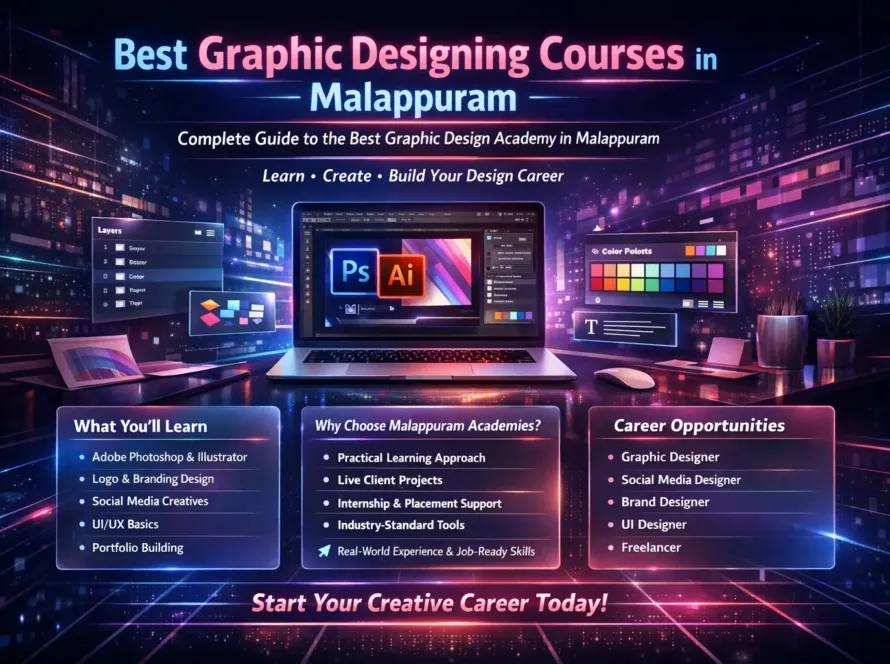
Graphic design has become an important skill across industries as businesses increasingly depend on visual communication. From social media posts and advertisements to branding, websites, packaging, and promotional materials, professional design plays a major role in how businesses communicate with their audiences. For students and aspiring designers, selecting the right training institute is an important step toward developing creative and technical skills. Knowing How to Choose the Best Graphic Design Academy in Malappuram can help learners select a program that matches their career goals.
One of the first factors to consider is the course curriculum. A good graphic design program should cover the fundamental principles of design, including typography, colour theory, composition, layout, visual hierarchy, branding, and creative concepts. These fundamentals help students develop a strong design foundation before moving into more advanced projects.
Software training is another important aspect of graphic design education. Students should gain practical knowledge of industry-standard applications such as Adobe Photoshop, Illustrator, and InDesign. Depending on the course, additional tools for UI design, digital illustration, motion graphics, and other creative areas can also be useful. The ability to work confidently with professional design software can improve career opportunities.
Practical training should also be a major consideration when selecting an academy. Graphic design is a skill that improves through regular practice. Students should have opportunities to work on posters, social media creatives, logos, brochures, advertisements, business cards, presentations, and branding projects. Practical assignments allow learners to apply design concepts and develop their creative problem-solving abilities.
Portfolio development is another important part of professional graphic design training. A portfolio showcases a designer’s skills, creativity, style, and ability to handle different types of projects. A quality academy should guide students in creating and organizing a professional portfolio. Including a variety of well-executed projects can help candidates present their abilities to employers, agencies, and freelance clients.
The experience and approach of trainers should also be considered. Experienced mentors can provide useful feedback, explain professional design practices, and help students improve their work. Instead of simply teaching software functions, trainers should encourage learners to understand why certain design decisions work and how visual communication can be improved.
Students should also consider whether the academy provides project-based learning. Working on realistic projects gives learners an idea of how professional design assignments are handled. It can also help students understand client requirements, deadlines, revisions, creative briefs, and presentation techniques. These experiences can make the transition from classroom learning to professional work easier.
Career support is another factor worth considering. After completing a graphic design course, students may explore opportunities as Graphic Designers, Visual Designers, Brand Designers, Social Media Designers, UI Designers, or Freelance Designers. Resume preparation, interview guidance, portfolio reviews, certification support, and career counselling can help learners prepare for these opportunities.
The learning environment also matters. Students should look for an academy that provides access to suitable software, practical resources, project guidance, and a supportive atmosphere. Whether the course is classroom-based or online, learners should have sufficient opportunities to interact with trainers and receive feedback on their work.
Ash Academy focuses on practical and career-oriented creative education for students who want to develop professional design skills. With structured training, practical assignments, project guidance, and portfolio development, students can gradually improve their technical knowledge and creative abilities. Exposure to real-world design requirements can also help learners understand what employers and clients expect from professional designers.
Before enrolling, students can compare the course syllabus, training duration, software covered, practical projects, portfolio support, trainer experience, certification, and career assistance offered by different institutes. Looking beyond course fees and focusing on the overall learning experience can help students make a better decision.
Choosing the Best Graphic Design Academy in Malappuram ultimately depends on the quality of training, practical exposure, portfolio opportunities, and career support provided by the institute. A well-structured program can help beginners develop their creative foundation while giving aspiring professionals the skills needed to work confidently on real-world design projects.