A web application often needs to remember what a user is doing. When someone adds a product to a cart, opens a menu, or enters information into a form, the interface must respond to those actions.
In React, state management helps developers control these changing parts of an application.
What Is State in React?
State represents information that can change while an application is running. For example, a shopping cart may begin empty and update whenever a user adds or removes an item.
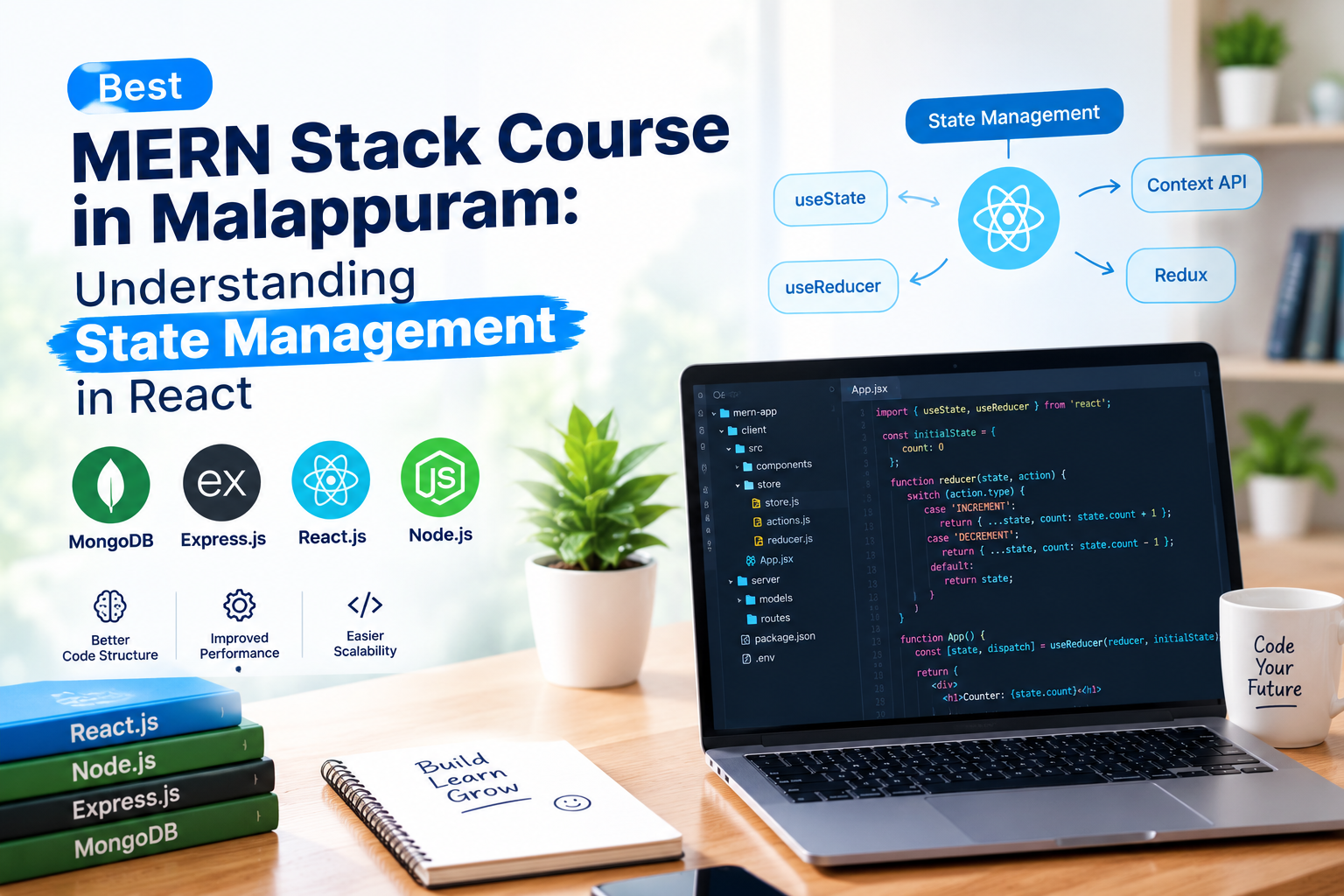
React allows developers to manage component state using tools such as the useState Hook. When the state changes, React can update the relevant parts of the interface.
Understanding this concept helps developers build interactive applications instead of static pages.
When Does State Management Become More Complex?
In a small application, managing state within individual components may be straightforward. However, as an application grows, several components may need access to the same information.
Consider an e-commerce website where the navigation bar displays the number of items in the cart while the product page allows users to add new items. Keeping this information consistent across components requires thoughtful state management.
Developers can use approaches such as lifting state up, Context, or external state management libraries depending on the application’s requirements.
Learn Through Practical Development
When choosing the Best MERN Stack course in Malappuram, look for training that explains concepts like state management through practical projects. Building interactive applications helps learners understand not only how a feature works but also why a particular implementation is useful.
Ash Academy’s Advanced MERN Stack programme includes six months of training followed by six months of internship, providing a structured path towards practical development experience.
For aspiring developers, finding the Best MERN Stack course in Malappuram means looking for opportunities to apply concepts, solve problems, and build projects that demonstrate their understanding of modern web development.
With consistent practice, state management becomes easier to understand and apply to increasingly complex applications.